Off the Grid, On Purpose: Meet the Young Americans Going Dark with Paper, Pens, and Zero Regrets
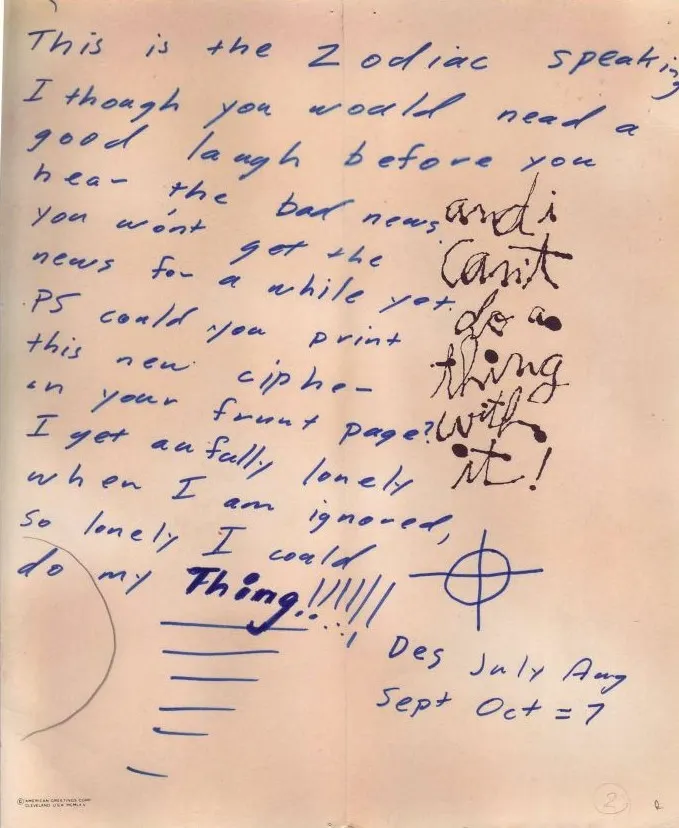
Photo: Zodiac Killer, Public domain, via Wikimedia Commons
There's a woman in Albuquerque — she asked us to call her Maren — who hasn't used a password manager in two years. She doesn't use cloud storage. Her calendar is a pocket-sized notebook she bought at a dollar store. When she needs to communicate something sensitive with her small circle of friends, she writes it by hand, seals it in an envelope, and drops it in a mailbox like it's 1987. She's 26 years old.
"People look at me like I've lost my mind," she says, laughing. "But I'm the one who actually knows where my information is."
Maren isn't alone. Across the country, a loosely connected countermovement is taking shape — one built not on new apps or encrypted platforms, but on the deliberate rejection of digital infrastructure altogether. Call it the analog resistance. Call it a vibe. Either way, it's real, it's growing, and it's a lot more organized than you'd expect from people who refuse to use group chats.
The Anxiety Underneath
To understand why someone in 2025 would voluntarily choose paper over pixels, you have to understand what the past several years have felt like for younger Americans who grew up chronically online. Data breaches. Algorithmic manipulation. The slow creep of surveillance capitalism into every corner of daily life. The moment you realize your phone has been listening — or at minimum, that it feels like it has.
"I didn't wake up one morning and decide to go analog," says Deshawn, a 29-year-old from Detroit who now runs what he calls a "correspondence circle" — essentially a private letter-writing club with about a dozen members scattered across the Midwest. "It was more like a slow accumulation of discomfort. Every app wanted more access. Every platform changed its privacy policy. I got tired of being the product."
Deshawn's group communicates almost entirely through physical mail. They have loose protocols — rotating addresses, a simple substitution cipher for anything they consider genuinely private, and an agreed-upon schedule for check-ins. It sounds elaborate, but he insists it's not. "It's actually way less complicated than managing fifteen different apps," he says. "And it's more fun."
That last part matters. Because while anxiety is clearly part of the fuel here, it's not the whole engine.
Paper as Ritual, Not Just Protest
Spend any time in these communities and you start to notice that the appeal of analog life isn't purely ideological. There's something tactile and almost ceremonial about the whole thing that digital communication just can't replicate. The weight of a letter. The permanence of ink. The fact that someone sat down, thought about what they wanted to say, and wrote it out with their actual hand.
Lena, a 24-year-old in Portland, got into paper mapping after a camping trip where her phone died and she realized she had absolutely no idea how to navigate without GPS. What started as a practical skill turned into something she describes as almost meditative. She now keeps a hand-drawn map of her neighborhood — annotated with notes about which coffee shops have good back exits, which streets flood in winter, which blocks have the best trees for sitting under.
"There's something that happens when you draw a place instead of just looking it up," she says. "You actually know it. It lives in your head differently."
This is the part of the analog resistance that tends to get lost when mainstream outlets cover it — the genuine pleasure people are finding in slowing down their information intake and making it physical. It's not all doom and gloom about Big Tech. Some of it is just people rediscovering that handwriting feels good.
The Codes People Are Actually Using
Okay, but let's talk about the codes, because that's where things get genuinely fascinating.
Simple substitution ciphers — where each letter maps to another letter or symbol — are popular because they're easy to learn and hard to crack without the key. Some groups use book ciphers, where messages reference specific page and line numbers from a shared physical book. Others have developed their own shorthand systems that look like gibberish to outsiders but are perfectly readable to members of the group.
"We use a modified Pigpen cipher," says Marcus, a 31-year-old in Chicago who runs a zine focused on low-tech communication methods. "It's not unbreakable or anything. But it's enough to make casual snooping not worth the effort. And honestly, the act of encoding something makes you think more carefully about what you're actually saying."
Marcus is quick to point out that none of this is about hiding illegal activity. It's about reclaiming a sense of privacy that digital life has systematically eroded. "Privacy used to be the default," he says. "Now you have to opt into it, and even then it's not guaranteed. We're just opting in the old-fashioned way."
The Community That Doesn't Have a Hashtag
One of the stranger paradoxes of the analog resistance is that it does have an online presence — it just tends to be scattered and ephemeral. Reddit threads, Discord servers, the occasional Substack newsletter. But the most committed participants describe a deliberate effort to keep the core of their community offline and therefore harder to scrape, monetize, or infiltrate.
In some cities, there are physical meetups. Zine fairs. Letter-writing workshops hosted at independent bookstores and community centers. A few people mentioned leaving notes in specific locations — a kind of analog dead drop — for others who know to look.
"It sounds very spy thriller," admits Deshawn, "but it's mostly just people who want to feel like their communication belongs to them."
That's probably the most honest summary of what's driving all of this. Not a conspiracy theory. Not a tech phobia. Just a generation that grew up having their attention harvested and their data sold, finally deciding to take something back — one handwritten letter at a time.
Is It Practical? Mostly No. Does That Matter? Also Mostly No.
Let's be real: going fully analog in 2025 is genuinely inconvenient. You can't split a dinner bill with a handwritten note. Your landlord probably wants an online payment. Job applications live on LinkedIn whether you like it or not.
Most of the people in this movement aren't claiming otherwise. They're not living off the grid in a cabin somewhere (though a few of them wouldn't mind it). They're using selective analog practices alongside their digital lives — carving out specific spaces where the algorithm doesn't follow.
Maren puts it simply: "I still have a phone. I'm not a monk. I just decided that some parts of my life don't need to be online. And weirdly, those are the parts that feel most like mine."
Somewhere in that sentence is the whole thing. The signal these people are sending isn't really about technology at all. It's about ownership. About deciding what gets to be private, what gets to be slow, and what gets to exist only in the physical world — seen only by the eyes it was meant for, carried only in the hands that chose to hold it.
In an era where everything is tracked, that's not regression. That's a pretty radical act.