Clack Back: The Writers Who Threw Their Laptops Out and Never Looked Back
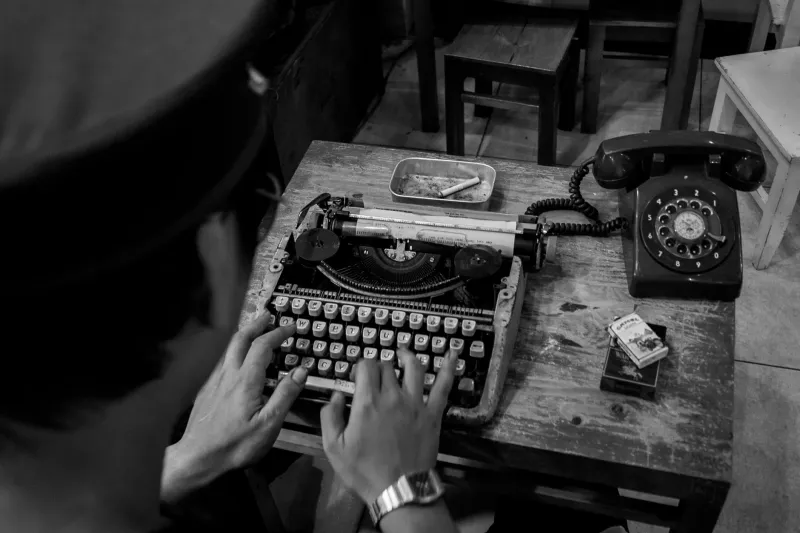
There's a particular sound coming out of certain apartments and coffee shops lately. Not the soft, apologetic tap of a MacBook keyboard. Something louder. More deliberate. More committed. It's the sound of a Olivetti Lettera 32 or a Royal Quiet De Luxe doing exactly what it was built to do — and a new generation of writers is making that sound on purpose.
Call it the typewriter insurgency. Call it a collective nervous breakdown dressed up in mid-century hardware. Either way, it's real, it's growing, and it has absolutely nothing to do with aesthetic Instagram photos of vintage office equipment (well, mostly nothing).
The Machine That Can't Spy on You
Ask Marcus Delray, a freelance journalist based out of Portland, Oregon, why he switched to a 1967 Smith Corona and he won't talk about nostalgia. He'll talk about surveillance.
"Every document I wrote on Google Docs was being processed, analyzed, potentially fed into training data," he says, not particularly calmly. "My drafts weren't mine. They were product."
Delray made the switch two years ago after reading the fine print on several cloud-based writing platforms he'd been using for assignments. What he found — broad data licensing clauses, behavioral tracking, AI-assisted "suggestions" that felt more like nudges — sent him to eBay at midnight looking for a portable manual typewriter. He found one for $47 including shipping.
"The typewriter has no terms of service," he says. "It doesn't learn from me. It doesn't optimize me. It just types."
This is the argument you hear again and again inside this particular corner of creative counterculture: the mechanical typewriter isn't retro tech, it's resistant tech. It produces output that exists only on paper until you choose otherwise. It doesn't autosave to a server. It doesn't suggest synonyms calibrated to maximize engagement. It doesn't know what you wrote yesterday, or last year, or ever.
Distraction as a Design Feature
Beyond the surveillance conversation, there's a second, equally impassioned argument being made by this community — and it's about the nature of the writing process itself.
Naomi Chu, a novelist living in Albuquerque who's working on her third book entirely on a 1950s Hermes 3000, describes her laptop years as a kind of cognitive warfare.
"I'd sit down to write and within four minutes I'd be reading about something completely unrelated," she says. "Not because I'm weak-willed. Because the machine was designed to pull me away. Every notification, every tab, every little red badge — that's all intentional. It's engineered distraction."
The typewriter, she explains, offers something that no productivity app, focus timer, or website blocker has ever genuinely replicated: architectural impossibility. You cannot check Twitter on a 1953 Royal. You cannot get a Slack notification. The internet does not exist on that machine. The choice to focus isn't a discipline you have to maintain — it's baked into the hardware at a mechanical level.
"My output tripled," Chu says flatly. "Not because I'm some kind of monk now. Just because there's literally nothing else to do but write."
The Correction Tape Philosophers
What's interesting about the typewriter revival — and what separates it from a simple nostalgia trip — is the philosophical framework that's coalesced around it. These aren't people who wish it was 1962. They're people who understand exactly what 2024 is and have made a calculated decision to opt out of specific parts of it.
Online communities like r/typewriters and dedicated Discord servers have become gathering points for what some members call "analog resistance" — a loose ideology that treats the deliberate use of non-networked tools as a form of political and creative self-preservation. The typewriter sits at the center of this because it's functional, affordable (decent machines regularly appear at thrift stores and estate sales for under $50), and produces a permanent physical artifact.
There's also something about the commitment a typewriter demands. You can't quietly delete a bad sentence. You cross it out, or you retype the whole page. That friction, counterintuitively, seems to produce better first drafts for many writers who've made the switch. You think harder before you press the key because pressing the key means something.
"Writing on a typewriter taught me that my first instinct is usually pretty good," says Terrence Okafor, a poet and professor in Chicago who uses a 1970s Olympia SM9. "On a laptop, I'd revise constantly, obsessively, in circles. The typewriter made me commit. And committing made me braver."
Not a Luddite Manifesto
It would be easy — and lazy — to frame all of this as technophobia or backward-looking romanticism. The writers involved are quick to push back on that characterization.
Delray still files his stories digitally. He just types them on the typewriter first, then transcribes the final version. Chu uses email and has a website. Okafor posts his poems online. None of them are living off the grid in a log cabin rejecting modernity wholesale.
What they're doing is something more surgical: identifying specific points in their creative workflow where digital tools actively work against them, and replacing those specific points with something that doesn't. The typewriter isn't an escape from the 21st century. It's a firewall inside it.
"People assume this is about being precious," Okafor says. "It's not. It's about knowing which tools serve you and which tools are using you. Once you see that distinction, you can't unsee it."
The Signal in the Keys
Typewriter sales have been quietly climbing for years. Companies like Swintec still manufacture new models. The refurbishment market has exploded. Repair shops that specialize in manual typewriters — once a dying trade — are reporting waitlists.
What the mainstream tech conversation tends to miss is that for a growing number of working writers, this isn't a hobby or an aesthetic choice. It's a professional recalibration. A decision that the creative act is worth protecting from the infrastructure that increasingly surrounds it.
The laptop will always be there when you need to send the file. The cloud will always be there when you need to store it. But the first draft — the terrifying, unoptimized, unsurveilled, genuinely yours first draft — that can happen somewhere else entirely.
Somewhere with a ribbon that needs replacing and keys that leave a slight impression on the page.
Somewhere that has never heard of your engagement metrics.
Somewhere that just types.