Spinning Backwards: The Hackers and Weirdos Keeping the Floppy Disk Alive as an Act of Digital Defiance
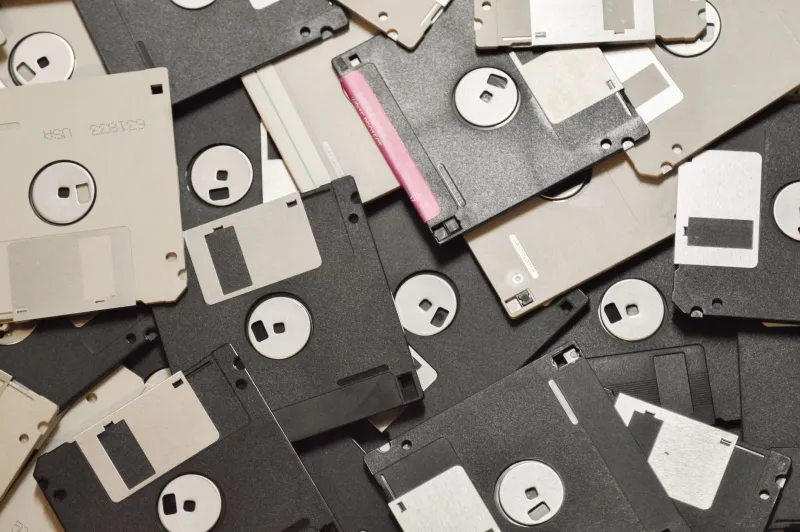
Somewhere in a church basement in Columbus, Ohio, a 23-year-old named Marcus is selling floppy disks out of a cardboard box. Not vintage ones sealed in plastic for collectors. Working ones. Formatted, labeled, ready to hold data. The guy next to him is offloading a stack of IBM ThinkPads from the early 2000s. The woman across the folding table has ZIP drives. Real ZIP drives. And every single person browsing this underground computer swap meet looks like they should be on a skateboard or arguing about shoegaze online — not haggling over the price of a 1.44MB storage medium that most people haven't thought about since the Clinton administration.
"People think I'm doing a bit," Marcus says, holding up a disk with a hand-drawn label that reads LOCAL ONLY. "I'm not doing a bit."
This is the floppy disk underground, and it is somehow, improbably, growing.
The Cloud Isn't the Sky — It's Someone Else's Server
To understand why a cohort of digitally fluent young Americans is voluntarily downgrading their hardware, you have to understand the specific flavor of distrust that's been marinating in certain corners of the internet for the last decade. It's not technophobia. These people love computers. They can write scripts, flash firmware, build their own machines from salvaged parts. What they hate is the infrastructure — the always-on, always-syncing, always-watching ecosystem that modern computing has become.
"The cloud is a metaphor designed to make you forget you're handing your files to a corporation," says Delia, a 26-year-old from Portland who runs a DIY server collective out of her apartment using machines that predate the Obama administration. "Once you remember that, the whole thing becomes kind of insane. Why would I want Google to have my stuff?"
The answer, for Delia and people like her, is: they don't. So they've opted out. Not by going offline entirely — that's a different scene — but by building what they call "air-gapped" or "sneakernet" workflows, where data moves on physical media between machines that never touch the internet. Floppy disks. USB drives. Burned CDs. Even cassette tapes, in some cases, loaded with audio-encoded data the way 1980s home computers used to do it.
The floppy disk is the movement's unlikely mascot, partly because of its absurd limitations — 1.44 megabytes is genuinely less than a single smartphone photo — and partly because those limitations are sort of the point.
The Virus-Proof Internet Nobody Asked For
Here's the thing about a floppy disk: it can't be remotely wiped. It can't be updated without your knowledge. Nobody can push surveillance software onto it from a data center in Virginia. The threat model is different, almost charmingly so — you're worried about magnets and humidity, not zero-day exploits.
For the more technically minded members of this scene, obsolete storage formats are part of a broader philosophy about computing that prioritizes physical control over digital convenience. They're building local networks — sometimes called "mesh nets" or just "the local" — that pass files between neighbors using whatever media is available. Some of these networks are surprisingly sophisticated, running old bulletin board system (BBS) software that makes the whole thing feel like stepping into 1993.
"We've got a BBS running in my neighborhood with about forty regular users," says Trevor, a 29-year-old in Detroit who helped set the thing up. "You dial in — well, you connect, it's not actual dial-up, but the software thinks it is — and you can post messages, share files, chat. It's completely local. There's no way to surveil it from outside because it doesn't connect to anything outside."
The security appeal is real, even if it comes wrapped in irony. These systems are genuinely difficult to surveil at scale. There's no API to scrape, no terms of service to invoke, no server farm to subpoena. The data lives on physical objects in physical rooms, and getting to it requires showing up in person.
Swap Meets and Salvage Culture
The hardware feeding this movement comes from a surprisingly robust secondary market. Electronics recyclers. Goodwill bins. Estate sales. The kinds of church-basement swap meets where Marcus hawks his floppy disks. There's a whole ecosystem of people who've figured out that the machines most people threw away in the early 2000s are actually perfect for this kind of computing — they're powerful enough to run useful software, simple enough to understand completely, and cheap enough that losing one to hardware failure isn't a catastrophe.
The swap meet circuit has its own culture, too. Part technical bazaar, part community organizing, part countercultural hangout. You'll find retired IT guys with boxes of enterprise hardware they liberated before it got shredded, alongside college students who've never owned a Windows machine that wasn't secondhand. The transactions are often cash-only, sometimes barter. People share repair knowledge freely. Someone always knows how to reflash a BIOS.
"It's the most functional community I've ever been part of," says Jess, 24, who drove two hours from rural Indiana to attend a swap meet in Indianapolis. She came for a working floppy drive. She left with that plus a functional connection to a local BBS and an open invitation to a weekend workshop on building your own operating system from scratch. "Nobody's trying to sell you anything. Everyone just wants the stuff to keep working."
Regression as Resistance
The philosophical underpinning here is something these communities have been working out in real time, and it's more coherent than it might first appear. The argument, roughly, is that technological progress as delivered by Silicon Valley has been progress toward a specific set of values — convenience, connectivity, monetization of attention — that not everyone actually wants. Choosing older technology isn't nostalgia or Luddism. It's a refusal to accept that those values are inevitable.
Delia calls it "refusing the upgrade." Marcus calls it "opting out of the stack." Trevor just calls it "not being an idiot about your data." Whatever the vocabulary, the underlying logic is consistent: if the newest technology is also the most surveilled, the most dependent on corporate infrastructure, and the most fragile to service outages and policy changes, then maybe the newest technology isn't actually the best technology for the job.
There's something quintessentially American about this, actually — the DIY ethos, the distrust of centralized authority, the instinct to build your own thing rather than accept the official version. It maps onto a long tradition of homebrew computing culture that stretches back to the Homebrew Computer Club in 1970s California, where a bunch of hobbyists who didn't think IBM or Xerox had their interests at heart started building their own machines. The floppy disk underground is, in some ways, just the latest chapter.
The Signal That Doesn't Need a Tower
None of this is going to topple Google. Everyone involved knows that. The floppy disk underground isn't a revolution; it's a subculture, and it seems pretty comfortable with that status. The people in it aren't trying to convert anyone. They're building something for themselves — a way of computing that feels honest to them, that they control, that can't be taken away by a terms-of-service update or a data breach or a company going under.
Marcus, packing up his box of disks at the end of the swap meet, puts it simply: "I know this stuff is old. I know it's limited. But it's mine. Like, actually mine. Nobody can reach into my floppy disk from a server room."
He snaps the box shut. Someone asks if he'll be at the next one.
"Obviously," he says.