Wrong Number, Right Vibe: The Teens Turning Phone Calls Into Avant-Garde Audio Gold
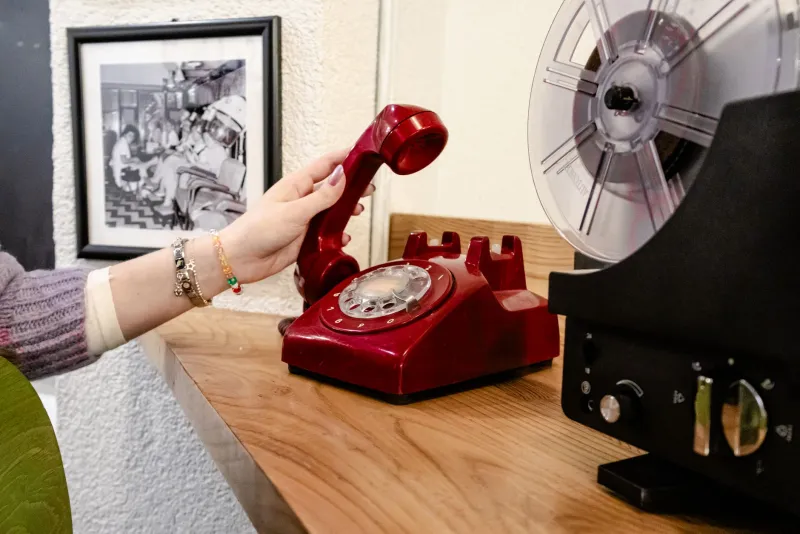
Somewhere in a private Discord server with a name you'll never guess and an invite link that expired forty minutes ago, a seventeen-year-old from Akron is uploading a three-minute audio piece built entirely from a wrong-number call her grandmother received last March. The caller was trying to reach a pharmacy. Her grandmother talked to him for eleven minutes anyway. The resulting track — layered under a low drone, chopped into rhythmic fragments, and laced with the hiss of an old cordless phone — has been downloaded 200 times by people who will never meet each other.
This is phone call art. And it's weirder, more legally complicated, and more emotionally resonant than it has any right to be.
Static as Medium
The practice doesn't have a clean name yet, which is honestly part of its appeal. Some people in these communities call it "call collage." Others say "wire art" or just "phone pieces." What they share is a foundational impulse: the belief that the telephone conversation — one of the most intimate and overlooked sonic spaces in American life — is a completely untapped creative resource.
Think about what lives inside a phone call. The nervous breath before someone says something hard. The weird silence when a connection drops for half a second. The background noise of someone else's kitchen, their TV, their dog losing its mind over something outside. These artists argue that none of that texture exists anywhere else. It can't be faked in a studio. It can't be reconstructed. It's a document of lived experience that most people delete from their call logs without a second thought.
For a growing number of young creators — many of them already deep in experimental music communities, others coming from visual art or even just boredom — that texture is the whole point.
The Recordings Themselves
Sources vary. Some artists record their own calls with full knowledge and consent — a conversation with a parent, a long rambling catch-up with a friend, a deliberately weird interaction with a telemarketer. Others lean into found material: wrong numbers that stumbled into something unexpectedly human, customer service calls that turned strangely philosophical, family arguments overheard on speakerphone. A smaller, more controversial subset records without any disclosure at all.
That last category is where things get genuinely thorny. In the US, phone recording laws operate on a patchwork of state-level consent rules. Federal law requires only one-party consent — meaning you can legally record a call you're participating in without telling the other person. But eleven states, including California, Florida, and Illinois, require all parties to consent. Record someone in a two-party-consent state without telling them, and you're potentially looking at criminal liability, not just an ethics lecture.
Most of the artists operating in these spaces are aware of this, at least loosely. "We talk about it constantly," says one Discord moderator who goes by the handle Mireille_Static and agreed to speak on background. "There's basically a rule in our server that if you post something and can't explain where it came from, people are going to ask. Not everyone cares, but a lot of us do."
The community has developed its own informal ethics framework — imperfect, self-policed, and occasionally ignored, but present. Recordings of strangers are generally anonymized. Voices are often pitched, filtered, or distorted enough to obscure identity. Some artists add a text disclaimer to their uploads: recorded with consent or one-party, single state. It's not a legal shield. But it signals intent.
What the Art Actually Sounds Like
Describing this stuff is difficult, which is maybe the most honest endorsement you can give it.
Some pieces are ambient — a conversation about nothing much stretched into a twenty-minute drift, the words becoming texture rather than meaning. Others are rhythmically aggressive, the natural cadence of speech chopped and rearranged until it sounds like percussion. There's a whole subgenre built around wrong numbers specifically, treating the accidental intimacy of a misdial as a kind of readymade poetry. One widely shared piece consists entirely of a man repeatedly trying to explain to a stranger that he has the wrong number, his patience slowly evaporating over six attempts, each one layered on top of the last until it becomes a round, then a drone, then something that sounds genuinely liturgical.
The influences are all over the place. You'll hear nods to musique concrète, to Negativland's culture-jamming tape collages, to the spoken word experiments of early hip-hop. Some of it sounds like the Caretaker. Some of it sounds like a film school project. A lot of it sounds like nothing else.
Why the Phone, Why Now
It's worth asking why the telephone is having this particular moment as an artistic medium when everything else is moving toward video, visual content, and the ever-expanding scroll.
Part of the answer might be exactly that. The phone call is one of the last communication formats that remains genuinely private — no algorithm is serving it to you, no engagement metric is measuring how long you stayed on. When two people talk on the phone, they're inside something that the attention economy hasn't fully colonized yet. For artists who grew up entirely online, that feels radical.
There's also something about voice specifically — unfiltered, unedited, stripped of the visual performance that video demands. A voice on the phone cracks when it's trying not to. It speeds up when it's nervous. It goes quiet in ways that mean something. These artists are arguing, implicitly, that the voice is the most honest data we produce, and the phone is still the best way to capture it raw.
"A face does a lot of work to protect you," says one artist who distributes her work under the name Corded. "On the phone, there's nowhere to hide. That's the whole thing for me. That's why I keep going back to it."
Underground by Design
None of this is on Spotify. None of it is on SoundCloud, really — or if it is, it's buried under aliases and unlisted links. The distribution model is intentionally fragmented: Discord servers, encrypted file shares, the occasional physical release on cassette tape mailed to people who know to ask. The obscurity isn't just aesthetic posturing. Given the legal ambiguity of some of the source material, keeping a low profile is practical.
But it also creates a kind of community that's genuinely rare online right now — one where access means something, where the audience is self-selected and engaged, where nobody's chasing an algorithm. The work circulates because people want it to, passed from listener to listener like a secret worth keeping.
Which, when you think about it, is exactly what a phone call is.